
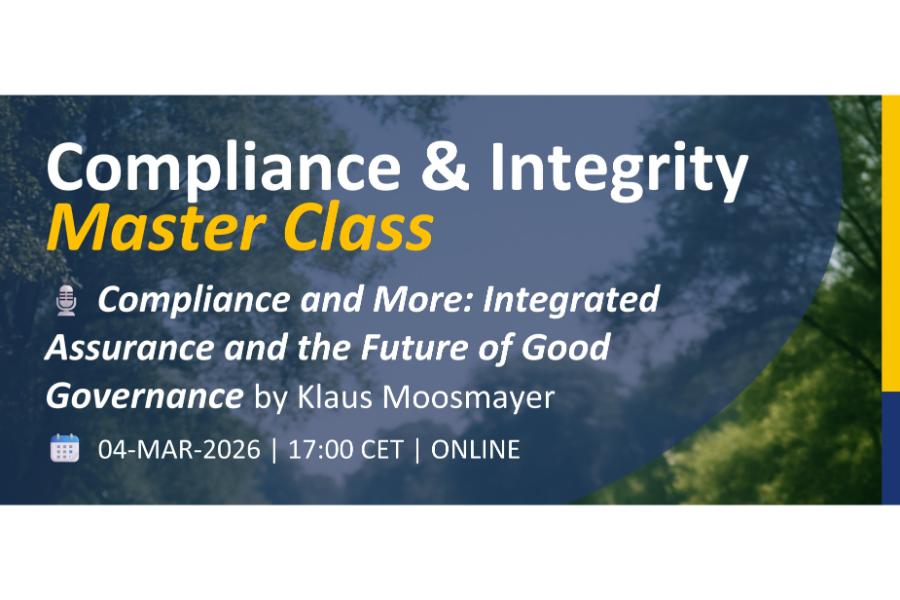
Compliance & Integrity Master Class Episode #1
Compliance and more: Integrated Assurance and the Future of Good Governance” by Klaus Moosmayer
macim
About the event:
The new event series “Compliance & Integrity Master Classes” designed by Viadrina Compliance Center aims to complement the ongoing teaching within the Master's program “Compliance & Integrity Management” at the European University Viadrina Frankfurt (Oder). As part of the monthly webinars, leading international experts from academia, industry and NGOs are invited to report on current challenges for the compliance officers. Times have never been as turbulent as they are now, which is particularly challenging for the compliance profession. Compliance & Integrity Master Classes are not just an excellent teaching format, but also provide practising compliance officers with high-quality expert updates on the latest compliance topics. Within the classes, after the lecture of an expert on the announced topic, there will be time for questions and answers. Following the event, there will be an opportunity to talk to current and former MACIM students and learn more about the master's program. The master classes are open to the public, however a free registration is required.
We look forward to meeting you virtually at the Compliance & Integrity Master Classes!
Prof. Dr. Bartosz Makowicz
MACIM Head of Studies
Technical information: Participation in the event is free of charge. Please register using the form below. See you soon!
The first MACIM Master Class brought together practitioners, academics, and students to discuss the evolving landscape of governance, risk, and compliance. The session focused on the concept of Integrated Assurance and its potential to strengthen trust and improve governance structures within organizations.
The Master Class was delivered by Klaus Moosmayer, one of the most recognized international experts in corporate compliance and integrity management. His insights drew on extensive professional experience in global governance structures and corporate compliance leadership. Mr. Moosmayer currently serves as Member of Advisory Board at Deutsche Bank and previously held the role of Chief Ethics, Risk & Compliance Officer at Novartis and Chief Compliance Officer at Siemens, where he played a key role in the transformation of the company’s compliance and integrity framework.
Below, we summarize the key take-aways from the lecture:
Trust under pressure
According to the Edelman Trust Barometer 2025, 61% of respondents globally have a sense of grievance, believing that government and business make their lives harder and serve narrow interests. This growing skepticism highlights the importance of credible governance structures and effective assurance systems within organizations. At the same time, experts increasingly warn of “governance gaps.” While traditional governance models provide clear role definitions and oversight structures, they often lack cross-functional coordination and effective knowledge transfer between different functions.
In many organizations, governance is formally structured across three lines: the board at the strategic level, the executive management responsible for implementation, and the vertical risk and compliance functions that provide oversight. However, this structure does not always ensure integrated perspectives or coordinated action.
Growing regulatory complexity and questioning the rule of law
Over the past two decades, the regulatory landscape has expanded significantly. What once focused primarily on anti-corruption and antitrust compliance has developed into a complex framework that now includes human rights due diligence, ESG requirements, sanctions regimes, export controls, data protection, and artificial intelligence governance. At the same time, the rule of law is increasingly being questioned in parts of the world, which creates additional challenges. In such an environment, adherence to rules becomes not only a legal requirement but also a cultural and leadership issue within organizations.
The challenge of organizational silos
Despite the growing complexity of regulatory requirements, many organizations still operate with fragmented governance structures. Risk management, compliance, legal, internal audit, ESG, and strategy functions frequently work independently in separate silos. This fragmentation can lead to duplicated processes, inefficiencies, and inconsistent risk assessments across the organization.
Integrated Assurance as a holistic approach
The Master Class highlighted Integrated Assurance as a potential solution to these challenges. Rather than creating another layer of bureaucracy, Integrated Assurance promotes collaboration, horizontal governance structures, and a shared understanding of risks across functions. A central element of this approach is the integration of risk management, compliance, and governance processes, enabling organizations to reduce duplication while improving the quality and consistency of oversight.
The Assurance Leader or Business Steward instead of Compliance Officer
As governance models evolve, so too does the role of the compliance professional. The traditional perception of compliance officers as “corporate police” is increasingly outdated. Instead, the emerging profile is that of an Assurance Leader or Business Steward as a professional who combines technical expertise with strategic thinking, collaboration skills, and the ability to influence organizational culture while maintaining independence and the capacity to challenge. Such a role could also be positioned at executive board level, providing a cross-functional perspective on governance, risk, compliance, and
integrity issues. This broader overview enables more integrated reporting, coordinated decision-making, and strategic oversight across the organization.
Leadership and incentives for change
Implementing an integrated assurance model requires strong leadership support. A clear tone from the top, a formal mandate, and genuine cross-functional cooperation are essential for overcoming organizational silos. However, organizational change is often influenced by economic considerations. Many stakeholders focus primarily on financial metrics, cost efficiency, and budget allocations. For this reason, legislative incentives and clearer regulatory expectations may play an important role in accelerating the adoption of integrated governance models.
Integrated Assurance was identified as a promising framework for strengthening trust, improving coordination between governance functions, and preparing organizations for the challenges of modern regulation and technological transformation.
We would like to thank Mr. Moosmayer for his highly exciting and forward-looking lecture!
Zurück zur News-Übersicht
Beitrag teilen: